
After Andreva loses her parents to the fever in 1243, she is summoned to southern France to care for her dying grandmother and finds herself in the middle of the Albigensian crusade. Her loyalties and beliefs are challenged by those around her and especially by the Church she loves.
Saturday, November 16, 2019

Tuesday, November 12, 2019
Resurgam

Since publishing my medieval historical novel, Shadows of Montsegur, A Tale of the Cathars, a lot of life has happened. Of the six novels I've offered to the world, Shadows is the most significant--it's story, its message, its value to literature. I researched and wrote for seven years, and Dennis and I visited the location in France where the story actually happened. I felt good in publishing when I did. Our society has so much controversy about freedom, so the novel's message is timely.
Before I published Shadows of Montsegur, my traditional publisher was showing signs of financially struggling; not paying their authors was the obvious sign. My critique group and other writer friends told me to try self-publishing. They had taken that route and found success. After much deliberation, I took the plunge, hired a professional book cover designer and also the best editor I knew, and became an indie author.

But only two months into it, I was diagnosed with lung cancer--no pain, no symptoms, and I'd never smoked a cigarette in my life! I can't blame my carcinoid tumor for my plummeting book sales, but there is something about the C word that downs your spirit. All optimism that my novel would make a big bang in the historical fiction world flew out the window, and all I wanted to do was hide in my house (snuggled on my comfy couch) until the whole cancer thing was over. Who could feel exuberant about book promoting? This too would pass, I'd tell myself, and then I'd get back to my novel.
But when I had recovered from having my lung removed, I could do very little, and it wasn't the physical that restrained me. I was one of the fortunate who, by removing an obnoxious tumor, removed the cancer and it was gone. I didn't need radiation or chemo. I should have been enthusiastic and bouncing on the gym floor. But I couldn't muster any desire to bounce, or to promote. And I had no confidence to do so, no confidence to put myself out there as the author of a fantastic story. Had my confidence (I know I've used the word 3 times now) been removed along with the lung I now missed? I might have gotten as far as setting up a promo, and yet could not get myself to click the "submit" or "post" button. The air had gone out of my balloon. I was as wimpy as my protagonist on the first page of her story. I felt doomed.
My husband took me back to Montsegur, France. It was what I needed--to be reminded of why I had written Shadows, its message, and what the Cathars had gone through because they would not denounce their beliefs.
Then life took a turn. We volunteered to spend the summer of 2019 in central Wyoming at a historical site called Martin's Cove. It filled my need to hide (in the middle of nowhere) while we served six months with 39 other couples who lived high standards and were fun to be with. We hosted at the visitors center and assisted youth groups who came to reenact pioneer treks wearing pioneer clothing and pulling handcarts across the valley in the never-ceasing Wyoming wind. It was rejuvenating, but I hardly did any book promoting.
My husband took me back to Montsegur, France. It was what I needed--to be reminded of why I had written Shadows, its message, and what the Cathars had gone through because they would not denounce their beliefs.
Then life took a turn. We volunteered to spend the summer of 2019 in central Wyoming at a historical site called Martin's Cove. It filled my need to hide (in the middle of nowhere) while we served six months with 39 other couples who lived high standards and were fun to be with. We hosted at the visitors center and assisted youth groups who came to reenact pioneer treks wearing pioneer clothing and pulling handcarts across the valley in the never-ceasing Wyoming wind. It was rejuvenating, but I hardly did any book promoting.
 |
| Reenactment of pioneer treks |
After six months, we returned. It is time to procrastinate no longer.
If you have read Shadows of Montsegur, A Tale of the Cathars, THANK YOU, and please leave a review or comment on Amazon. Reviews mean everything to authors.
If you enjoy learning about our history, I encourage you to read Shadows of Montsegur, A Tale of the Cathars. It recounts a tragic event in history, but will leave you uplifted, with a better understanding of what mankind has gone through.
Has something ever happened that put your plans on hold? Share in the comments.
After six months, we returned. It is time to procrastinate no longer.
If you have read Shadows of Montsegur, A Tale of the Cathars, THANK YOU, and please leave a review or comment on Amazon. Reviews mean everything to authors.
If you enjoy learning about our history, I encourage you to read Shadows of Montsegur, A Tale of the Cathars. It recounts a tragic event in history, but will leave you uplifted, with a better understanding of what mankind has gone through.
Has something ever happened that put your plans on hold? Share in the comments.

Saturday, March 16, 2019

Saturday, February 16, 2019
Lavelanet of the Ariege

 |
| Medieval street in Lavelanet |
 |
| Touyre River |
As a result of the Treaty of Paris in 1229, Toulouse became subject to King Louis of France, changing the world of the Languedoc forever. Lavelanet fell under the lordship of Mirepoix.
 |
| River Touyre |
 |
The first Catholic church in Lavelanet was established by the monks of Saint Sernin in the 9th century. The first building served for hundreds of years, and the present church house was built in the 1600's. Here are a few photos of the interior.
 |
| Madonna |
 |
| Confessional |

 |
| Countryside |
 |
| Textile factory smoke stack now stands |
The green countryside allows for a lovely scenic drive.
The ruins of the fortress of Montsegur can be seen in the distance from the village of Lavelanet.
 Walk the streets of the enchanting village of Lavelanet in the Shadows of Montsegur. Learn about the Cathars, their beliefs, and why they had to choose between their religion and life.
 |
| One of the oldest structures in Lavelanet |
 Walk the streets of the enchanting village of Lavelanet in the Shadows of Montsegur. Learn about the Cathars, their beliefs, and why they had to choose between their religion and life.
Tuesday, February 12, 2019
The Beginning of the Inquisition--A Mission of Love Gone Awry

The 11thcentury dawned with a new religion spreading rapidly across northern Italy and southern France, creating such a hub-bub and raising caution with Catholic leadership. The papacy labeled this religion’s claim to authority from Christ, and their profoundly different theology, as heretical. The Church saw its growth as a threat, and sent priests to the Languedoc to bring these lost souls back into the fold. Sincere preachers taught and debated with the Cathars for decades, finding some success, but most heretics resisted converting or denouncing their faith.
During these thriving years, this new religion was not particularly known as Cathars, but asBons Hommes,or the Good Men. The term Cathar has become popular to distinguish them since their demise. This religion attracted new believers because Cathar preachers were tradesmen and their own neighbors, and taught in the language the people understood. They charged no taxes, and lived peaceful lives of self-discipline.
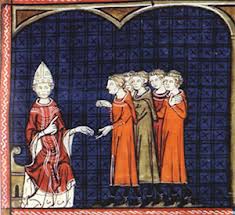
After years of fruitless persuasion, in 1209 the papacy abandoned its converting tactics and declared war against the Cathars.
The pope charged the Dominican and Franciscan orders to track them down in what became known as the Albigensian Crusade--the beginnings of the Inquisition. The cry changed from “Convert them!” to “Exterminate them!” These priests who previously had preached with love and sincere intent on converting souls, almost overnight became the executioners of the Inquisition.
The most horrendous act that began the crusade happened at Beziers. In July 1209, the papal legate ordered to kill all in the city. But the objection was made that half the population were Catholics. “Kill them all. God will know his own!” the leader answered. Nearly twenty-thousand people died that day, as many Catholics as Cathars.
Crusades had been going on for centuries, but warriors had always fought in far off countries and with those considered heathens and enemies to Christianity. But now, reluctant soldiers were required to fight against neighbors and their own families who were Cathar believers. The war was too close to home.

 The Inquisition was initially meant to be temporary, but after Catharism was well under control, the killing went on for at least five more centuries to include Jews, Muslims, and anyone who dared to go against the established beliefs of the Church. One could not stand up for what he believed without being arrested, and even tortured until death. Millions died at the Inquisitors’ hands—ironically, by priests charged with teaching the Gospel of Love.
 |
Shadows of Montsegur tells of the Cathars' last days at the fortress of Montsegur.
Thursday, September 20, 2018
A Visit in Toulouse

Friday, May 25, 2018
Monday, December 4, 2017
Shadows of Montsegur, A Tale of the Cathars

A religious people are persecuted for their belief, driven from their homes, and must run from an extermination order issued by those who fear them.
The year is 1144. Andreva de Beringer is joyful upon her uncle’s summons to leave the abbey in Toulouse, where she is novice, to care for her grandmother, but she arrives in Lavelanet to find a village gripped by the turmoil and terror of the Inquisition. While Andreva strives to hold on to her family, her faith, and the man she loves, all around her Good Men (believers in the Cathar religion) must fight for the same—as well as for life itself.
In the right place, but at a dreadfully wrong time, and under the wrath of the Inquisition, might this faith-filled but naïve girl be forced to witness the massacre and burning of every Cathar man, woman, and child, and also lose the young farmer she loves?
The venturesome reader, students of history, and the romantic at heart can learn from this seldom-told tale of medieval history at its darkest.
Available at Amazon.
Monday, September 26, 2016
Tuesday, March 15, 2016
The Basilica of St. Sernin
|
In the beginning of Shadows of Montsegur, Andreva, a seventeen year-old novice at the convent affiliated with the Basilica of St. Sernin in Toulouse, France, is summoned by her Uncle Bostel to the Ariege village of Lavelanet in southern France to care for her grandmother.
The original St. Sernin (or St. Saturnin) was built in the 4th century. The abbey no longer remains and the basilica was rebuilt between 1080 and 1120. It is now surrounded entirely by the city of Toulouse. It is the largest remaining Romanesque building in Europe, if not the world. It is now listed in the UNESCO World Heritage Sites under the description: World Heritage Sites of the Routes of Santiago de Compostela in France.
 |
| The unique spire of St. Sernin |
 |
| the Ambulatory |
 |
| Street market |
 |
| Romanesque architecture |
 |
| St. Sernin's tomb |
 |
| Peter, James, and John |
 |
| Side entrance |
 |
| The crucifixion of Christ |
 |
| Relics |
 |
| Nave |
 |
| North Aisle |
 |
| Organ pipes |
 |
| Stairway to ambulatory |


Sunday, November 4, 2012
Interview with Medieval Author, Joyce DiPastena
One of my favorite Medieval authors is Joyce DiPastena. Her novels are Loyalty's Web, Illuminations of the Heart, and Dangerous Favor. She classifies her tales as historical romance, but with all the history and details she packs into each page, they are very historical.
I am fortunate Joyce granted me an interview today!
Joyce, what started you writing about medieval times?
 I fell in love with the Middle Ages during high school when I read a history book on the early Plantagenet kings of England called The Conquering Family, by Thomas B. Costain. I'd been dabbling with writing stories in other time periods--I always seemed drawn to historical settings for my early writing attempts--but for some reason, this book especially intrigued me. When I went to college (the University of Arizona), I decided to major in history. I consequently took courses in many various time periods, but my heart always beat a little quicker in my medieval history classes, so I took every medieval history class I could find. At the same time, I began my first full length novel and also set it in the Middle Ages. And I've never really looked back.
 What is it about the Medieval period that fascinates you and keeps you writing about it?
I don't really know why this particular period fascinates me so much. I'm fascinated by many time periods, ancient, medieval, Stuart, Regency, the American Revolution. But when it comes to writing, I just enjoy the medieval time period more than any other.
What keeps me writing about it? There are still so many fascinating things to explore! My books so far have touched on subjects such as medieval illumination, medieval Arthurian poetry and medieval politics. I've just completed two short medieval stories that incorporate medieval carol dancing and medieval reliquaries (highly decorated boxes that held objects believed by the Catholic Church to be holy, such as fingernail clippings, locks of hair, even vials of tears from the original twelve apostles or the saints that followed them).
I feel like I've barely scratched the surface of topics available to research and explore and share with readers in a story of one sort or another. I think it will be avery long time before I tire of writing about this time period!
What are your most trusted resources on details of that period?
I have a very extensive personal library of medieval research books that focus on multiple specialized topics, but here are some of the ones I find myself referring to for almost every story I write are:
The Castle Explorer's Guide, by Frank Bottomley
Pleyn Delit: Medieval Cookery for Modern Cooks, by Constance B. Hieatt and Sharon Butler 900 Years of English Costume, by Nancy Bradfield (I think this may be available under a different title now, but the same author)
English Costume from the Early MIddle Ages Through the Sixteenth Century, by Iris Brooke Medieval English Gardens, by Teresa McLean
A Baronial Household of the Thirteenth Century, by Margaret Wade Labarge
The Castle Explorer's Guide, by Frank Bottomley
Pleyn Delit: Medieval Cookery for Modern Cooks, by Constance B. Hieatt and Sharon Butler 900 Years of English Costume, by Nancy Bradfield (I think this may be available under a different title now, but the same author)
English Costume from the Early MIddle Ages Through the Sixteenth Century, by Iris Brooke Medieval English Gardens, by Teresa McLean
A Baronial Household of the Thirteenth Century, by Margaret Wade Labarge
Here are DiPastena's Medieval tales:


Thursday, September 20, 2012
The Names of Those Who Died at Montsegur
 Who were those Cathars who died at Montsegur on 16 March 1244? Click here to go to the list. There are several of the time who recorded the numbers of martyrs as between 200-240. Only heaven has all the names recorded, but this link will give you some we know who definitely lost their lives at Montségur.
Saturday, September 15, 2012
Lavelanet, France
Shadows of Montsegur takes place in Lavelanet in the French Ariege department. The village was built at the foot of a castle called Castelsarrasin (not the village of Castelsarrasin) that belonged to the Count of Foix. The castle was destroyed when Simon de Montfort's army attacked the village in 1212, and then rebuilt, but again destroyed by war. The the castle was torn down in 1964.

 On the left is a photo of the rebuilt castle before it was demolished, and on the right is its medieval fireplace.
The website I found the photos.
Here is another interesting site on Lavelanet.
 On the left is a photo of the rebuilt castle before it was demolished, and on the right is its medieval fireplace.
The website I found the photos.
Here is another interesting site on Lavelanet.

Subscribe to:
Posts (Atom)